

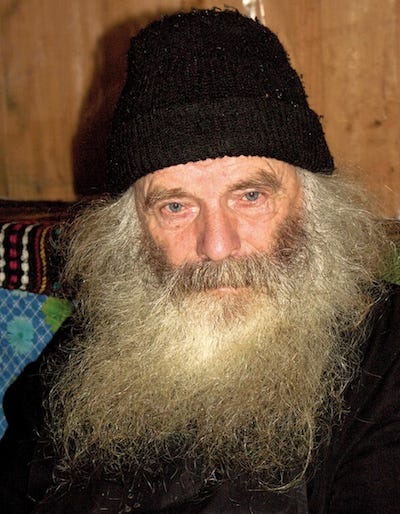
We should not think that “God will surely save me.”
If you are in danger of death and you are afraid of it, it means you still need repentance.
It is very important not to be overcome by anger in temptations, but to pray; to ask for God’s help.
The devil seeks in every way to trouble us and occupy our minds, but Confession helps us greatly.
When the Holy Spirit has touched someone’s heart, then his heart burns with longing for God, with longing for Jesus. When you stumble, devote yourself more to repentance.
Elder Proclu Nicau (1928-2017) - a short biography
Elder Proclu Nicau, baptized George, was born on November 13, 1928, in the village of Mitocu Balan, Neamt County, Romania. He entered the monastic community at Sihastria Monastery in Neamt County on November 1, 1948. In 1949, together with other members of the Sihastria brotherhood, he was sent to Slatina Monastery to help revive the monastic life there. He was formed spiritually under great elders of Romanian monasticism: Archimandrite Cleopas Ilie and Hieroschemamonk Paisius Olaru, both canonized in 2024 by the Romanian Orthodox Church.
His spiritual experience was further deepened through a life of withdrawal. After the Decree 410 from 1959, with the blessing of his spiritual father, Elder Cleopas, he chose a life of stillness. For decades, he lived in simplicity, in a small house on the outskirts of the village of Mitocu Balan.
He was known for his life of prayer, simplicity, and repentance, and for his counsel to both monastics and laypeople. He lived in a manner akin to the hermits of the Romanian tradition, emphasizing humility, vigilance over thoughts, and constant remembrance of God, and became widely regarded among the faithful as a bearer of the living patristic spirit in contemporary times.
(Decree 410 from 1959 was a communist-era law in Romania that severely restricted monastic life by imposing strict age and eligibility requirements for entering or remaining in monasteries (men under 55 and women under 50 were expelled), leading to the forced removal of thousands of monks and nuns and the closure or repurposing of many monasteries. Enforced through state pressure and the Securitate (Secret Police) between 1959–1964, it represented a major attempt by the atheist regime to suppress monasticism, viewed as a threat to state control and ideological conformity.)
Thank you